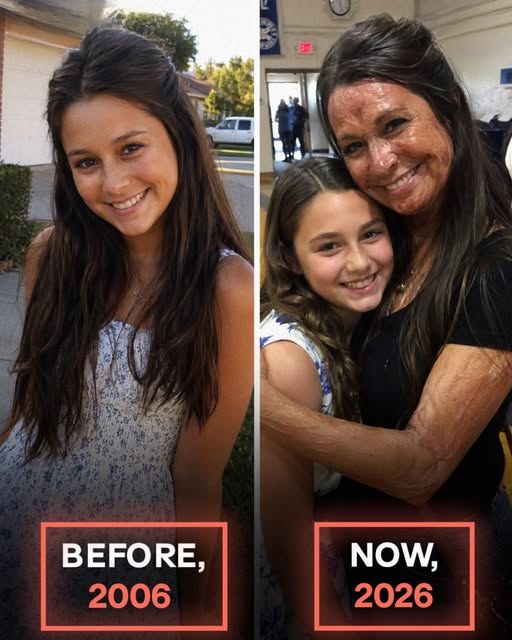
My daughter asked me not to show up at her school anymore because the other children laughed at my face, and I believed that was the hardest moment I would ever endure. I was wrong. The next morning, I stepped into her school auditorium ready to share one truth, only for a stranger to arrive and expose something far deeper.
Every morning I face the mirror before leaving home, and the same reflection greets me back. The left side of my face still carries what the fire took from me two decades ago. The burns run across my cheek, trace my jawline, and fade into my neck in thick, uneven scars that makeup can soften but never erase.
Twenty years is a long time to live with a face that changed overnight. Long enough to stop flinching at stares. Long enough to know which looks come from curiosity—and which come from cruelty.
THE LEFT SIDE OF MY FACE STILL CARRIES WHAT THE FIRE TOOK FROM ME 20 YEARS AGO.
I’m raising Clara on my own. My husband died after a long illness when she was just three, and since then it’s been me, my daughter, and my mother, Rose, living next door.
I work in a software company, splitting my time between office days and working from home. Clara is gentle, affectionate, and endlessly curious. She used to trace my scars with her fingertip and ask softly, “Mom, does it still hurt?”
And I would always tell her no. She would nod like that made everything okay.
Then came the day she asked me not to come to her school anymore. It was one of my remote work days, so I decided to pick her up myself.
“DOES IT STILL HURT, MOM?”
I parked by the curb and watched the children pour out of the building. Then I saw her. Clara stood with a small group of kids. One boy glanced toward my car, whispered something, and immediately covered his mouth while the others laughed.
I saw her reaction before I heard a word. Her shoulders tightened. Her head dropped. When she reached the car, she got in quickly, dropped her backpack harder than usual, and turned toward the window in silence.
“Hey sweetheart… what happened?” I asked.
“Nothing, Mom,” she said. Then, barely audible, “Mom… please don’t come to my school anymore.”
I almost pulled the car over right there.
“MOM… PLEASE DON’T COME TO MY SCHOOL ANYMORE.”
“I love you,” she whispered through tears, “but I can’t take them laughing at me.”
There are words that hit your ears, and words that hit your entire body. I kept my eyes fixed on the road because I knew if I looked at her, I would fall apart.
She told me everything in broken pieces. Their school was preparing a Mother’s Day event. Every child would bring their mother on stage and speak about her. Clara had been excited at first—until the teasing started.
One boy called me “the monster mom.” Another drew a scarred face in his notebook and slid it across the desk for others to see.
“I CAN’T TAKE THEM LAUGHING AT ME.”
My hand instinctively went to the scar along my jaw.
“Grandma picks me up instead,” Clara said quietly. “No one says anything then.”
I looked at her but couldn’t respond right away.
“They all stare at you, Mom. They laugh at me because of you. I don’t want it anymore.”
She was only eleven—hurt, exhausted, and trying to survive children who had learned cruelty before kindness.
I pulled over and turned toward her. “Do you know how I got these scars?”
Clara looked down. “From the fire.”
“WHEN GRANDMA PICKS ME UP, NO ONE SAYS ANYTHING.”
I was sixteen when our apartment building caught fire in the middle of the night. People were rushing out. Then I heard children screaming from upstairs. I went back inside. I pulled them out. I saved them—but I lost the face I once had.
I never told that story often because I didn’t want my life reduced to one night.
I reached for her hand. “I’ll still come tomorrow. You don’t need to be ashamed of the truth.”
She pulled away. “You don’t understand what it’s like when they stare at you.”
“I do,” I said softly. “More than you think.”
She looked at me then—seeing I wasn’t angry, just deeply hurt in a different way.
“YOU DON’T UNDERSTAND WHAT IT’S LIKE WHEN THEY STARE AT YOU.”
Inside the house, my mother was slicing fruit in the kitchen. One look at Clara told her everything, so she stayed quiet.
I knelt in front of my daughter. “If anyone thinks they can laugh at you because of me, they need to learn what they’re laughing at.”
Clara shook her head. “Please don’t make it worse.”
“I’m trying to make it stop,” I said gently. “And I will.”
My mother said softly, “You’ve spent twenty years surviving people’s stares. You’re not afraid anymore.”
Clara whispered, “I just wanted one normal day.”
I squeezed her shoulder. “Then I’ll try to give you one.”
“THEY NEED TO UNDERSTAND WHAT THEY’RE LAUGHING AT.”
The next morning I chose a navy dress. Not because it would protect me, but because it made me feel steady. I pinned my hair back and applied makeup carefully, knowing it could never hide what was beneath.
My mother stood in the doorway. “Are you sure about this?”
“My daughter is being mocked for something she didn’t choose,” I said. “I can’t stay home.”
She nodded once. “Then go and make them uncomfortable.”
That made me smile, just briefly.
“MY DAUGHTER IS BEING MOCKED FOR SOMETHING SHE DIDN’T CHOOSE.”
In the car, Clara sat silently.
“What are you going to say?” she asked.
“You’ll hear it when they do,” I replied.
She tightened her grip on the door handle when we arrived.
“I hate this,” she whispered.
“I know,” I said, stepping out first and offering my hand.
“YOU’LL HEAR IT WHEN THEY DO.”
The auditorium was already filling. Mothers and children sat together in rows. Whispers started before I even noticed them.
One by one, children went on stage. One spoke about her mother’s cooking. Another about bedtime prayers. Applause followed each story, and Clara sank lower with every clap.
Then her name was called.
She didn’t move. I stood, took her hand, and walked with her toward the stage.
THE WHISPERS NEVER FULLY STOPPED.
Halfway there, something hit my shoulder. I picked it up—a crumpled paper drawing of a monster with scars across its face.
Clara gasped behind me.
From the back, a boy shouted, “That’s the monster’s kid!”
Laughter spread in pockets. Some parents looked away. Others stayed silent.
I took the microphone from Clara’s shaking hands.
“Hello, I’m Clara’s mother,” I said. “And these scars are not the worst thing that ever happened to me. The worst part is watching my child be laughed at because of them.”
I paused.
“Twenty years ago, a fire trapped people inside our building. While everyone ran out, I went back in when I heard children screaming…”
“THAT’S THE MONSTER’S KID!”
Before I could finish, the doors burst open.
A young man rushed inside, breathing hard, and walked straight down the aisle.
“You’re laughing without knowing the truth,” he said loudly. “But you don’t know what she did.”
He stopped and faced Clara. “Your mother has been hiding something for twenty years.”
I recognized him instantly—Scott, Clara’s music teacher.
He turned to the crowd. “She didn’t just save three children.”
Silence fell instantly.
“YOUR MOTHER HAS BEEN HIDING SOMETHING FOR 20 YEARS.”
“She went back inside again,” Scott said, voice shaking. “Because I was still in there.”
The room went still.
“The building was collapsing. Firefighters shouted for her to stop. But she ran back in and carried me out.”
Clara turned toward me, frozen.
“Your mother didn’t just lose her face saving children,” he said. “She lost it saving me.”
“THAT CHILD… WAS ME.”
People lowered their eyes. The boy who had shouted earlier looked down at the floor.
“When my parents thanked her, she asked them not to tell the story,” Scott said. “She didn’t want me to grow up feeling responsible.”
I stepped forward. “You were just a child. That’s all you were.”
Clara stared at me like she was seeing me for the first time.
I knelt and held her hands. “I never wanted pity. I just wanted you to know scars don’t make someone less worthy of love.”
“SHE DIDN’T WANT ME TO GROW UP THINKING IT WAS MY FAULT.”
Clara broke down. “I was ashamed… and I let them laugh at you.”
I pulled her into my arms. “No, sweetheart. You were hurt.”
Behind us, the room stayed silent.
Then a voice whispered, “I’m sorry.”
It was the boy from the back.
“I LET THEM LAUGH AT YOU.”
Scott spoke quietly. “I recognized her the moment she walked in. I couldn’t stay silent again.”
I met his eyes through tears.
“I’ve waited twenty years to thank you,” he said.
“You don’t owe me anything,” I replied.
“I owe you everything.”
Then Clara took the microphone.
“This is my mom,” she said. “And she’s the bravest person I know.”
Applause filled the room.
“I OWE YOU EVERYTHING.”
On the way home, the car felt lighter.
“Why didn’t you tell me?” Clara asked.
“I didn’t know he was your teacher,” I said. “And I didn’t want my past to define everything about me.”
“I said something wrong,” she whispered.
“No,” I said. “You were hurt.”
“I SAID SOMETHING WRONG.”
At home, she stood in front of the mirror later and asked, “Do you hate your face?”
I turned to her. “No. Some days are hard. But it reminds me I survived.”
She cried. Then laughed through it.
For years I thought my scars were my heaviest burden.
I was wrong.
The hardest part was watching my daughter fear them before she knew the truth—and the most beautiful part was seeing her love me without fear after she did.
THE HARDEST PART WAS WATCHING MY DAUGHTER FEAR WHAT SHE DIDN’T UNDERSTAND.
Leave a Reply